
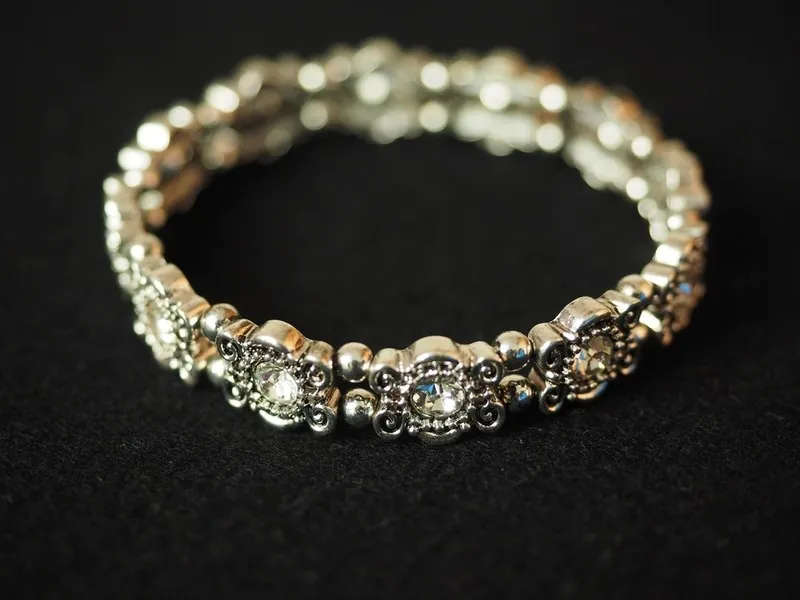
Three things set it: the aperture, where a wider opening gives a thinner sharp zone; the distance to the subject, where closer means thinner; and the lens and sensor. At the distances used for jewellery and small products, the zone can be thinner than the product itself, so the front of a ring is sharp and its back is soft. Phone portrait modes imitate a shallow depth of field in software and can blur parts of the product itself, such as a chain, a lace edge or loose threads.
The choice depends on the image. For packshots and main images on a plain background, the whole product should be sharp from front to back, and a blurred background adds nothing because there is nothing behind the product to hide; a narrower aperture and a tripod for the longer exposure do the job. For lifestyle and on-model images, a shallow depth of field separates the product from a busy setting. The focus then belongs on the garment, not on the model's eyes, whenever the two sit at different distances.
Closing the aperture as far as it goes does not give the sharpest result: past a point the whole image softens again, so most lenses are sharpest in the middle of their range. Where a product is deeper than any single sharp zone, focus stacking combines several frames. The check is made at full size on the far side of the product: the stitching, the clasp, the lettering on a label. Many marketplace rules reject blurry images, and a partly blurred product counts.